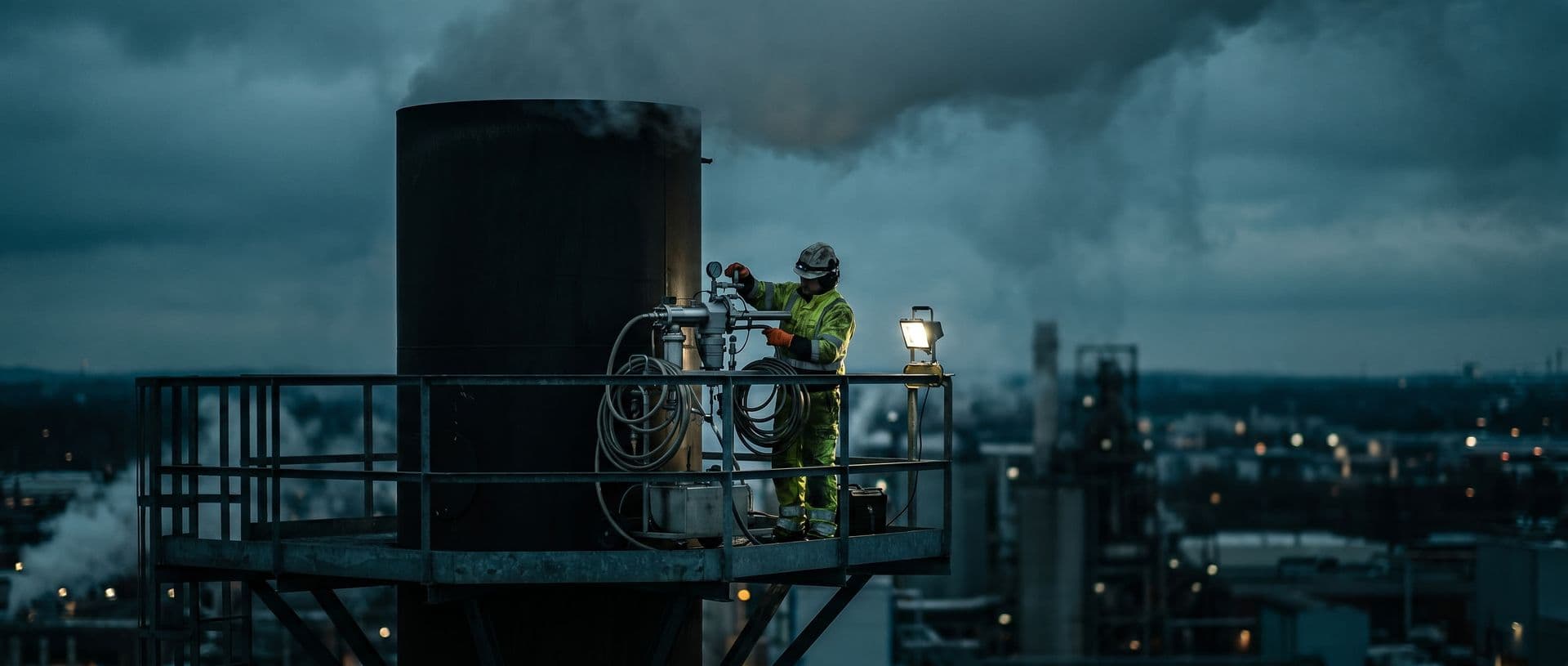
From the stack sampling point to the signed report, with each source evaluated by its own limit
Your lab lives in the field: isokinetic sampling on stationary sources, black smoke by the Ringelmann scale, indoor air in climate-controlled spaces. Gerencialab compares every result against the limit you register, saves the sampling conditions and works offline, even at the stack with no signal.
Who it is for
If your day means going into the field to measure atmospheric emissions, a generic system gets neither stack sampling nor visual smoke reading, and you fight it all day. Gerencialab is built for labs that really monitor air, from the stationary source releasing gas to the climate-controlled space that needs clean air.
Your stack comes back evaluated against the source limit.
Isokinetic sampling on stationary sources with particulate matter and gases such as SOx, NOx and CO. Each parameter arrives compared against the emission limit you registered for that source. You know on the spot if it passed.
Black smoke read by Ringelmann, recorded with proof.
The colorimetric density reading on the Ringelmann scale comes in with date, time, condition and a photo of the point. The reading is recorded and traceable, the way inspection demands.
Indoor air in climate-controlled spaces under control.
Indoor air quality monitoring with the climate-controlled space parameters evaluated against the reference values you register, following the applicable indoor air standard.
Ambient air quality framed by the right standard.
Each ambient air point is evaluated against the correct air quality standard. You deliver the monitoring without ever crossing the wrong limit.
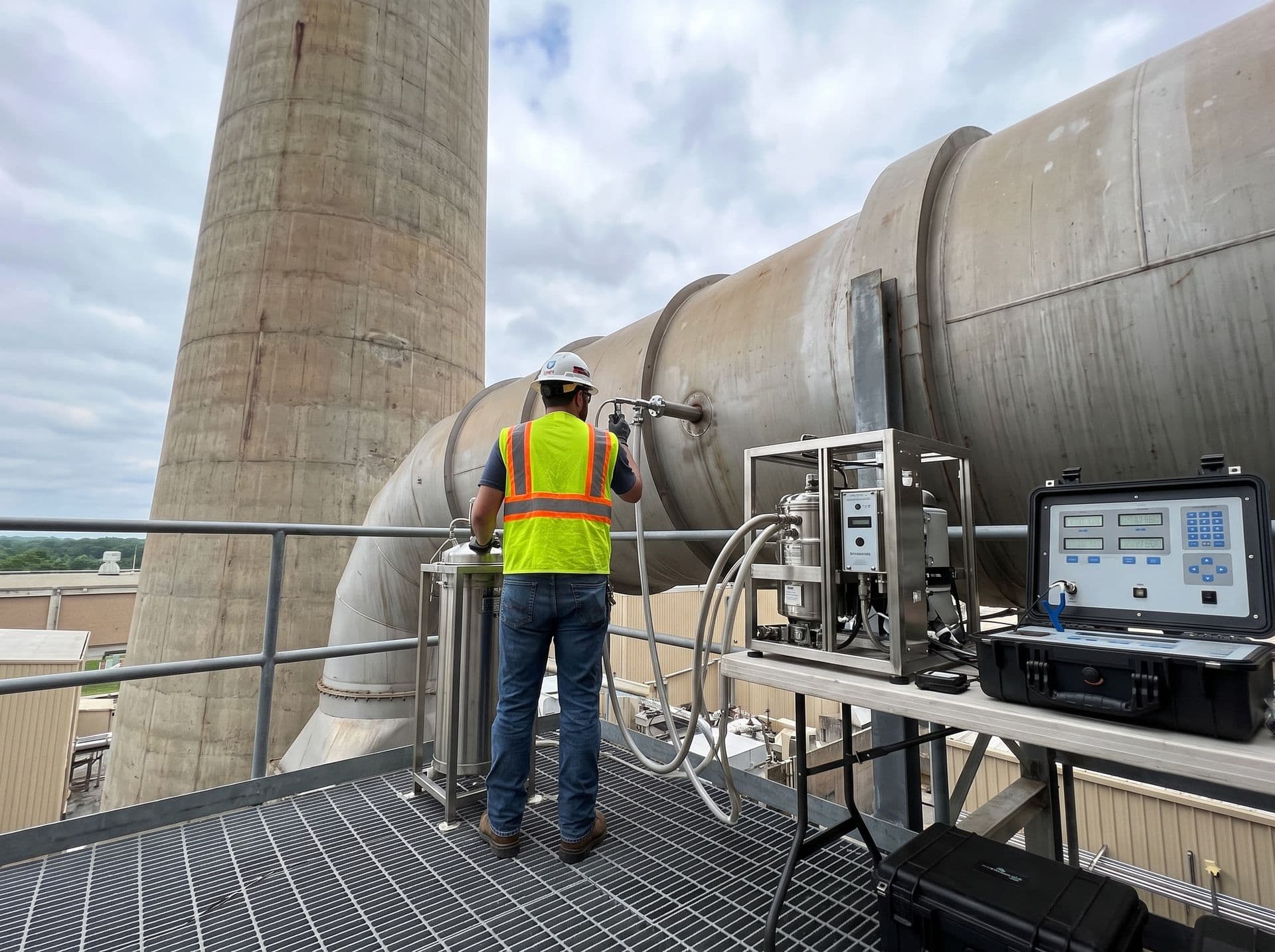
Sampling happens at the source, offline, with the Ringelmann reading recorded with a photo.
Your technician climbs the stack platform to run isokinetic sampling and read black smoke, almost always with no signal. The app saves the point, conditions and a photo in the field and syncs when internet is back.
- Isokinetic sampling on stationary sources, with the sampling conditions saved with the sample.
- Black smoke reading on the Ringelmann scale with grade, timestamp and a photo of the point.
- Offline app with GPS at the stack with no signal, syncing when the technician returns.
Emission limits inside the system
Your analyst stops chasing limits in a PDF and keeping a side spreadsheet. You register the regulations you use as a reference and Gerencialab compares every result against the right limit at the moment of entry. The screen shows what is within and what is out. The final call stays with your technical manager.
Stationary sources evaluated by the method and limit you use.
Isokinetic stack sampling follows US EPA and equivalent methods for particulate matter and gases. Register the parameters and the emission limit of each source once, and every collection comes back evaluated against them.
Ringelmann with the limit grade registered.
Black smoke colorimetric density has a maximum allowed grade. Register that limit and the field reading is compared against it, without relying on memory at report time.
Indoor air against the applicable standard.
Indoor air quality parameters for climate-controlled spaces come in with the standard's reference values, and every measurement comes back compared against them.
Each source on its own rule, no crossover.
In the same lab, the stack is evaluated by one limit, indoor air by another and ambient air by a third. Each sample pulls the right regulation for its source on its own.
The pains of measuring stack emissions
We know the routine of anyone measuring atmospheric emissions. Each point below became part of the system so you stop firefighting with it.
Field work all the time, without losing data on the way.
Stacks, climate-controlled spaces and ambient air points almost never have internet. The technician records everything on the phone offline, with GPS, and syncs when back online. Nothing is lost on the way there and back.
Sampling conditions must be recorded, not kept in your head.
Flow rate, temperature, pressure and point condition are part of the stationary source report. With dynamic forms, the technician notes everything on the spot and it stays saved, with no rain-soaked field paper to rely on.
Each source with its limit, no mixing up regulations.
Stack, black smoke, indoor air and ambient air do not follow the same rule. Register each one once and the system applies the right one to each sample, on its own.
Instrument and spreadsheet results without rekeying.
The gas analyzer and the calculation spreadsheet generate a file. You import that result instead of retyping readings, cutting the transcription error that shows up in the audit.
How Gerencialab solves it
From the field sheet to the report, with no rework in between.
The result tells you on the spot if it passed or exceeded the limit.
On entry, each parameter is compared against the source limit registered for that collection and anything out is flagged right away. Less manual checking, fewer table-reading errors.
Sampling happens even with no internet at the stack.
The app works offline, records point, photos and field data with GPS, and syncs later. Planned routes, registered points and route notifications, including by WhatsApp for the technician.
Sampling conditions stay saved with the sample.
Use dynamic forms to note flow rate, temperature, pressure and point condition. The system records what was entered, without inventing a calculation your method did not perform.
Your report comes out with the lab's identity, signed.
Configurable template with your header and footer, variables filled on their own, signature on the document and PDF generated on the spot. Each template version is controlled.
Each point and source stays traceable, from collection to report.
Register the points and each sample carries its source of origin, with a history of who did what and when. The Ringelmann reading comes in with photo and timestamp in the same record.
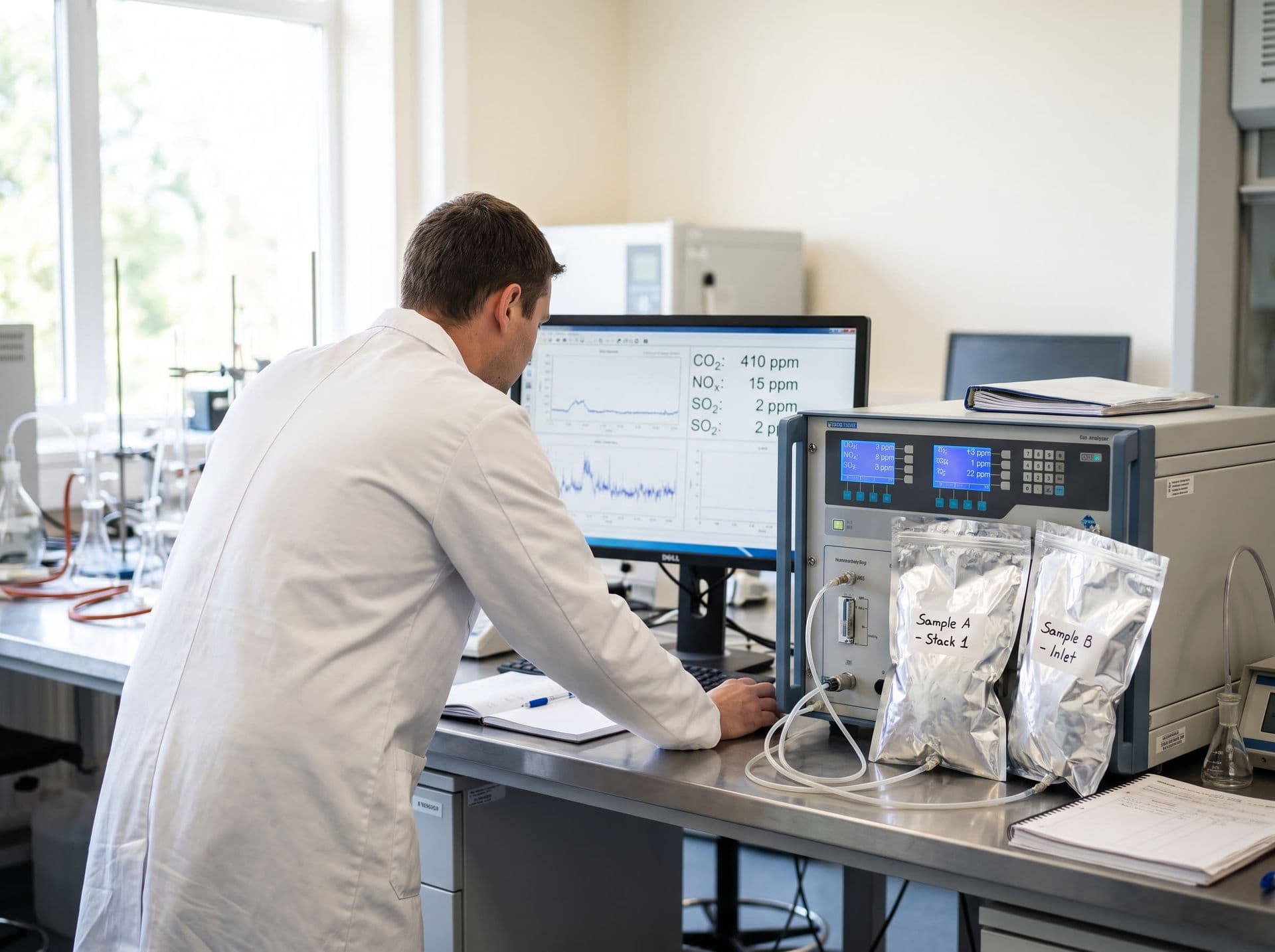
Each source is checked against its limit and the report comes out signed by the technical manager.
On entry, each parameter is compared against the limit you registered for that source and anything out shows up right away. The system structures the result; your technical manager reviews and signs the report.
- Each parameter compared against the source limit (stack, Ringelmann, indoor air, ambient air).
- Limits are references your lab registers; the system structures and exports the result.
- Configurable report, signed by the technical manager and as a PDF, traceable under ISO/IEC 17025.
Modules that matter most for air and emissions
Everything in one system. No module billed on the side.
Sampling and Logistics.
Your technician heads out with route and schedule in hand and records everything in the offline app with GPS, even at a stack with no signal. Recurring campaigns come scheduled.
Samples.
Each sample enters with a barcode or QR label and stays traced from intake to disposal, linked to its source of origin and with point photos.
Laboratory and Analyses.
Method and parameters ready by source, the result reviewed before it leaves, and import from gas analyzers and spreadsheets so no reading is retyped.
Quality Control.
QC aligned with ISO/IEC 17025, with reference materials and control evaluation, so you reach the audit with everything in place.
Reports and Templates.
Your report comes out in a configurable template, signed and as a PDF, with version control. Every document leaves standardized.
BI and Reports.
Dashboards and exports that organize what goes to the environmental agency and the indicators management needs to see.
Frequently asked questions
Does Gerencialab come with emission limits preloaded?
The system has a regulations registry where you record parameters and limits for each source and use them for automatic result evaluation. The limit database is maintained by your lab, which is responsible for accreditation. During onboarding we help you build that registry.
Does the system submit results directly to the environmental agency?
No. Gerencialab structures and exports your results (spreadsheet or PDF) so your team can organize the report to the environmental agency. It removes the rekeying work, but the submission is done by your team.
How do I record a black smoke reading on the Ringelmann scale?
The reading enters as a source parameter, with the grade read, date, time, condition and a photo of the point. You register the allowed limit grade and the system compares the field reading against it, keeping everything recorded and traceable.
Does the system calculate isokinetic sampling on its own?
Gerencialab records the sampling conditions you fill in the field (flow rate, temperature, pressure, point condition) and imports the result generated by your instrument or your calculation spreadsheet. It does not invent a calculation your method did not perform, it stores and evaluates against the limit.
Can different sources be evaluated against different limits?
Each source pulls the regulation linked to it. The stack compares by one limit, black smoke by another, indoor air by another and ambient air by another. You register each one once and the system applies the right one in each case.
Does it import gas analyzer results?
Yes, through import of results from instruments and spreadsheets. It is not real-time serial interfacing, it is import of the file generated by the analyzer or the analyst's spreadsheet.
See Gerencialab running with your emissions monitoring routine.
See a free demo and watch stack sampling happen offline, the Ringelmann reading come in with a photo, each source checked against your limit and the report come out signed, with examples from your collection type.